.png?imageMogr2/format/webp)







.png?imageMogr2/format/webp)
If you're shopping for a dash cam, 4K sounds like the obvious choice. But do you actually need it?
Not necessarily. A 4K dash cam can capture more fine detail than a 1080p model, but resolution alone does not determine real-world image quality. The image sensor, lens quality, HDR/WDR processing, low-light performance, bitrate, and heat management all shape what your footage actually looks like — and whether it holds up when you need it as evidence. This guide walks through what 4K genuinely delivers, where 2K sits as a middle ground, and when 1080p is still enough, so you can match the resolution to your driving instead of paying for detail you may never use.
.png?imageMogr2/format/webp)
What Does 4K Actually Mean in a Dash Cam?
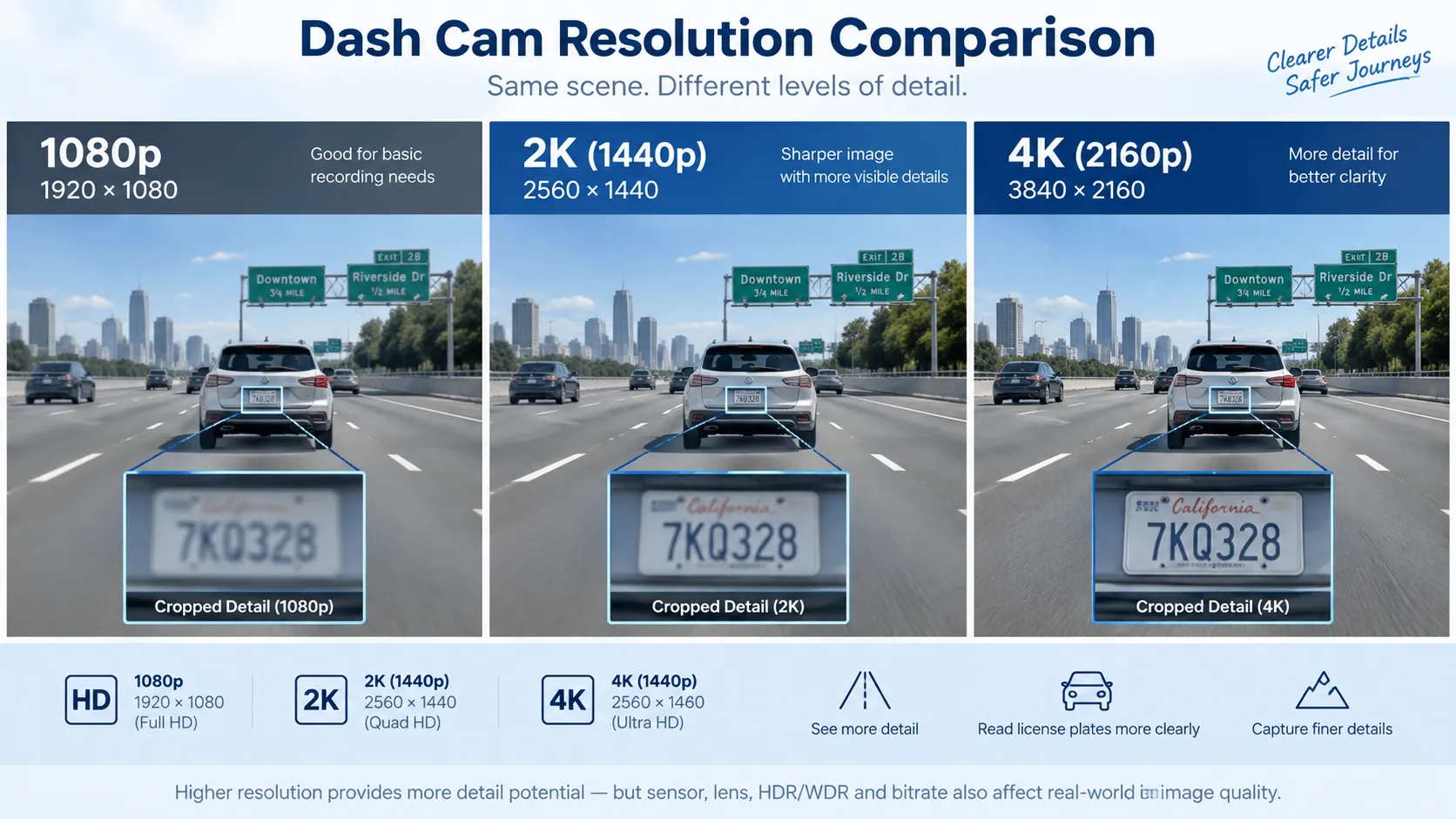
A 4K dash cam records at roughly 3840 x 2160 pixels — four times the pixel count of 1080p (1920 x 1080). More pixels spread across the same scene means finer detail in theory: license plates at greater distance, sharper roadside signage, and more usable frames when you zoom into a recording.
In practice, those extra pixels only translate into usable detail if the lens can resolve them and the sensor receives enough light. A 4K dash cam also places higher demands on storage and cooling, which is why well-designed 4K models pair the resolution with a high-endurance microSD card, an efficient codec, and a heat-tolerant build. Resolution is one part of a system — not a guarantee on its own.
When Is a 4K Dash Cam Worth It?
4K earns its price in situations where distance and detail work against you. Here is where the extra resolution actually helps.
Capturing License Plates at Distance
The farther away a vehicle is, the fewer pixels a 1080p camera can dedicate to its license plate — which is why distant plates often blur into unreadable white blocks. A good 4K dash cam can preserve more fine detail when vehicles are farther away, which can make license plates and road signs easier to inspect in recorded footage. If your main reason for buying a dash cam is evidence you can actually read, this is where 4K justifies itself.
Highway and Long-Distance Driving
At highway speed, vehicles close quickly and incidents develop over distance. Extra resolution gives you more margin: more detail survives in each frame, and you can crop into a 4K recording during review without it turning into a soft blur. For drivers who spend hours on interstates rather than minutes on local roads, 4K footage stays useful where 1080p starts to strain.
Ride-Share, Taxi, and Fleet Use
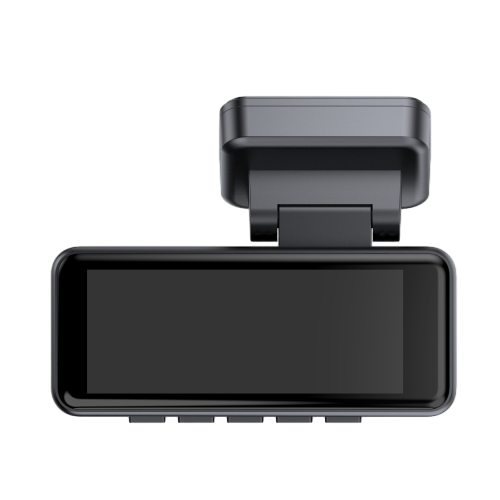
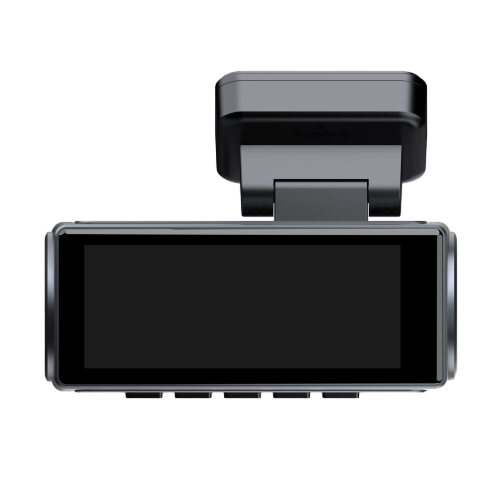
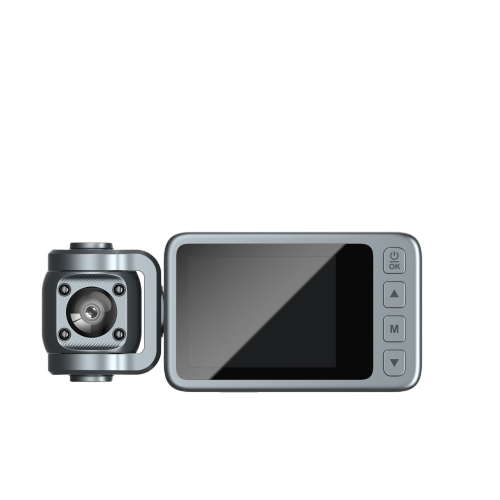
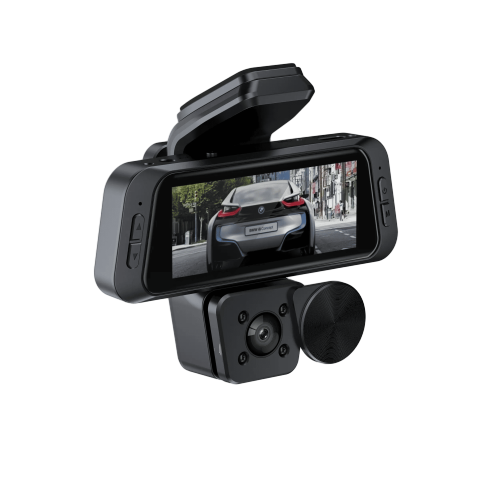
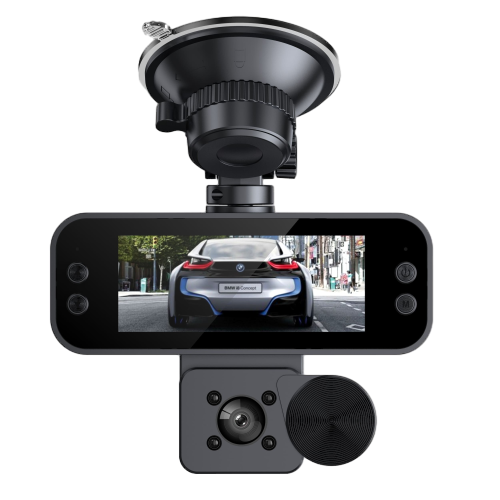
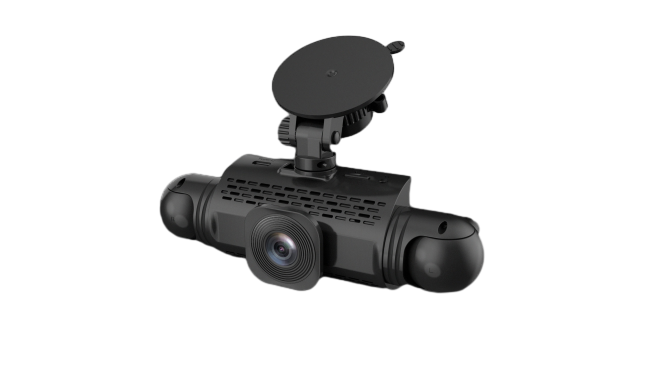
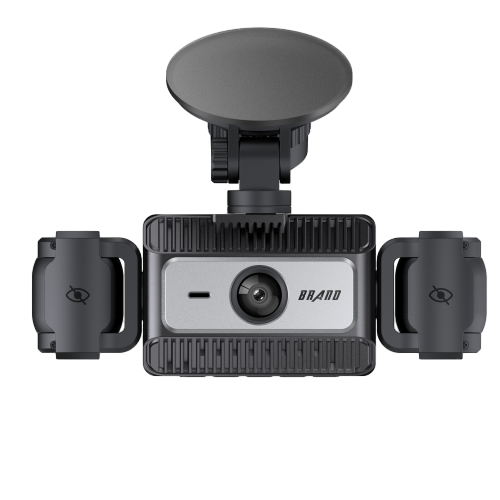
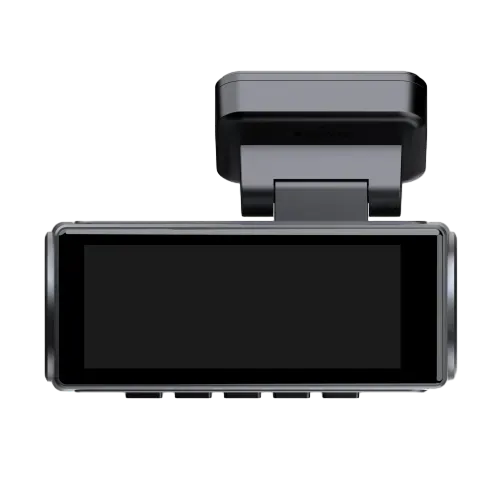
Commercial drivers face more disputes per mile than private motorists — passenger incidents, contested lane changes, parking damage. In these situations, the value of sharper footage compounds: paired with GPS overlay that logs speed and route, high-resolution video becomes a complete evidentiary record. Multi-channel systems such as the D3-1 4K+2K dual dash cam are built for exactly this use, recording the road ahead in 4K while a second channel covers the rear.
Scenic and Travel Recording
If your dash cam footage doubles as travel video — coastal highways, mountain passes, cross-country road trips — 4K holds up through editing. Stabilization, cropping, and color correction all cost resolution, and 4K gives you headroom that 1080p generally cannot spare.
When Is 1080p Enough?
Basic Daily Commuting
If you drive a short, familiar route at moderate speeds, 1080p records everything that matters. Plates of nearby vehicles stay readable, incidents are documented, and files remain small enough that a modest memory card covers days of driving. For pure accident documentation around town, 1080p remains a sensible choice.
Short-Distance Driving and Simplicity
Local errand driving produces fewer high-speed, long-distance situations where 4K pulls ahead. A 1080p camera also runs cooler and lighter on storage — worth considering for older vehicles without clean USB power or windshields that bake in summer sun.
Tight Budgets
If the choice is between a poorly built 4K dash cam and a reliable 1080p model with better imaging hardware, the latter may be the more sensible choice. Budget spent on a proven sensor, strong HDR, and a heat-tolerant design typically buys more real-world value than raw resolution.
What About 2K?
Why 2K Can Be a Practical Middle Ground
2K (1440p) sits between the two: noticeably more detail than 1080p, with generally lower storage and processing demands than 4K. For drivers who split their time between local roads and highways — and who want sharper footage without managing large 4K files — 2K can be a practical middle ground. As with any resolution, whether 2K delivers depends on the sensor, lens, and HDR processing behind it, not the number alone.
2K also shows up in a smart hybrid approach: pairing a 4K front camera with a 2K rear camera. This puts maximum detail where it matters most — plates and road signs ahead of you — while keeping rear-channel storage reasonable. The D2-1 dual dash cam takes exactly this approach, recording 4K front and 2K rear with GPS, WiFi, and parking monitoring in one system.
"Higher resolution can provide more detail — but resolution alone does not determine real-world image quality."
4K vs 2K vs 1080p: Side-by-Side Comparison
The table below compares the three resolutions across the factors that matter in daily ownership.
| Factor | 1080p | 2K | 4K |
|---|---|---|---|
| Image detail | Good | Better | Highest |
| Plate detail at distance | Limited | Better | Highest potential |
| Storage requirements | Lower | Moderate | Higher |
| Processing and heat demands | Lower | Moderate | Higher |
| Low-light quality | Depends on sensor | Depends on sensor | Depends on sensor |
| Best for | Basic daily driving | Balanced everyday use | Long-distance detail, fleet, evidence |
So, Which Resolution Should You Choose?
If you read nothing else, read this. Match the resolution to how you actually drive:
Choose 4K if
You frequently drive on highways where detail at distance matters.
You want maximum usable detail for recorded evidence.
You operate taxis, ride-share vehicles, or fleet cars.
You want flexibility to crop into footage during review or editing.
Choose 2K if
You want a noticeable step up from 1080p without 4K file sizes.
You drive a mix of local roads and highways.
You want to balance image detail against storage and heat demands.
You don't specifically need the highest resolution available.
Choose 1080p if
You mainly drive short daily commutes.
Basic incident recording is your main goal.
Your budget is limited — put it toward sensor and build quality instead.
You prioritize storage efficiency and simplicity.
What Matters More Than Resolution?
Resolution gets the marketing attention, but these factors shape your footage just as much. Weigh them before you commit to any camera.
Image Sensor and Low-Light Performance
Most collisions and disputes happen in traffic — mornings, evenings, and night — when light is worst. Larger pixels and better noise handling matter more at night than raw pixel count, which is why a well-designed 1080p dash cam with strong low-light performance can produce more useful nighttime footage than a poorly designed 4K model. Check real night samples before buying, not spec sheets.
HDR/WDR Processing
When you drive from a dark road into bright sunlight or approach a tunnel entrance, the camera has to handle very different brightness levels at the same time. Good HDR/WDR processing preserves detail that would otherwise be lost in deep shadow or blown-out highlights — the moments when standard exposure fails.
Lens Quality
The lens decides whether the sensor's detail reaches your footage. A sharp, well-corrected lens keeps the frame crisp from center to edge and gathers more light at dusk; a poor lens softens detail no matter what resolution the sensor records.
Bitrate, Compression, and Storage
4K recording generally requires more storage than 2K or 1080p, but the actual file size depends on bitrate, codec, frame rate, and compression settings. Higher resolution means paying closer attention to high-endurance microSD capacity and how cleanly the camera manages loop recording — not just buying a bigger card.
Loop Recording and Parking Mode
Reliable loop recording overwrites old files without corrupting the clip being written, and a G-sensor locks footage on impact so critical evidence survives. Buffered parking mode records before and after a detected impact, extending protection to the hours your car spends unattended.
Heat Resistance
A windshield in summer sun creates one of the harshest electronics environments in a vehicle. Excessive heat can affect long-term reliability, especially when a dash cam is mounted behind a windshield in direct sunlight. Supercapacitor-based power and a wide operating temperature range — the D2-1 and D3-1 are rated from -20°C to +70°C — matter more for longevity than any resolution figure.
How to Choose the Right Dash Cam for Your Driving
Work through this list in order. The first three items will narrow your choice faster than any comparison chart.
- List where you drive: local roads, highways, or both.
- Decide what the footage is for: personal records, insurance evidence, or commercial disputes.
- Pick resolution to match: 1080p for basic coverage, 2K for balance, 4K for maximum detail.
- Verify night footage quality with real samples, not marketing claims.
- Confirm loop recording, G-sensor locking, and buffered parking mode.
- Check storage demands against the memory card you plan to use.
- Confirm heat tolerance and power design for your climate.
Choosing a Dash Cam Manufacturer for OEM/ODM Projects
For brands and distributors, resolution is only one line in the specification. Yuaoheng Electronics manufactures a full dash cam systems range spanning single-channel 1080p units to 4K+2K dual-channel recorders with built-in GPS, WiFi app control, parking monitoring, and dual-lens HDR — engineered for wide temperature ranges and long service life. The D2-1 and D3-1 are current examples of how front 4K and rear 2K channels can be combined in one system.
As an OEM/ODM manufacturer, we support projects from light customization — logo and packaging — through drawing-based and sample-based development to full ODM cycles covering hardware, software, and app. See our OEM/ODM capabilities for details.
Frequently Asked Questions
Is a 4K dash cam worth it for everyday driving?
For mixed everyday driving, 2K often delivers the better balance, and 1080p covers basic incident documentation. 4K is worth the premium mainly when you regularly drive highways, need maximum evidence detail, or use the camera commercially. The deciding factor is where you drive and what you need the footage to prove — not the resolution number itself.
Is 2K enough for a dash cam?
For most drivers, yes. 2K captures noticeably more detail than 1080p — including plates at moderate distance — while keeping storage and heat demands well below 4K. If your driving mixes local roads with highway time, 2K is a practical middle ground, provided the sensor and HDR processing behind it are well designed.
Is 4K better at night?
Not automatically. Night performance depends far more on the sensor's light gathering, pixel size, and HDR/WDR processing than on resolution. Smaller 4K pixels can actually gather less light per pixel than larger 1080p pixels. Judge night quality from sample footage of the specific model, not from the resolution spec.
Does a 4K dash cam use more storage?
Generally yes — 4K recording requires more storage than 2K or 1080p. The exact file size depends on bitrate, codec, frame rate, and compression settings, so two 4K cameras can differ substantially. Plan on a high-endurance microSD card and check how the camera handles loop recording before you buy.
Can a 1080p dash cam still be good?
Absolutely. A well-built 1080p dash cam with a quality sensor, strong HDR, and reliable loop recording documents daily driving competently and often outperforms a cheap 4K model where it counts — night footage and long-term reliability. It remains a sensible choice for commuters and budget-conscious buyers.
Conclusion
A 4K dash cam delivers real value when distance, evidence, and commercial use are part of your driving — and it is unnecessary expense when they are not. 2K offers a genuine middle ground for mixed driving, and a well-designed 1080p camera still serves daily commuters well. Higher resolution can provide more detail, but resolution alone does not determine real-world image quality: the sensor, lens, HDR processing, storage design, and heat tolerance decide whether footage is actually usable.
Choosing the right resolution is only the first step. The number of camera channels, your night-driving needs, and your parking requirements all shape the right system too. Browse our complete product range to compare models side by side, or contact our team for a recommendation matched to your driving and your market.
.jpg?imageMogr2/format/webp)